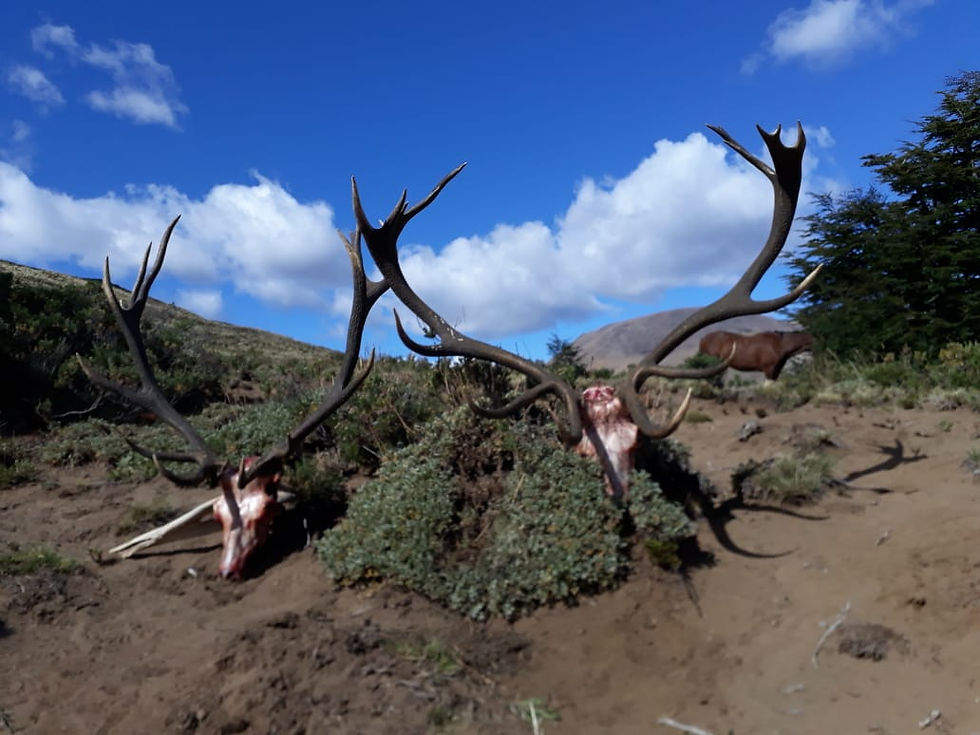
Water Buffalo Hunting in Argentina

Yes, you can hunt water buffalo in Argentina, and you hunt them free range. Asian water buffalo live wild in the calden brush of the La Pampa area, where we hunt them from March to August as an add-on to a red stag hunt: on foot, one-on-one, with rifle or bow, at 50 to 100 yards.
A mature bull is the biggest animal you can hunt in Argentina: more than 2,000 pounds, a long sweep of horn, and a home in cover thick enough that you rarely see him before he is close. This guide explains what a water buffalo is, why there are wild herds in La Pampa, how the stalk works in the brush and how it fits into a trip with us.
What Is a Water Buffalo?
The water buffalo (Bubalus bubalis), also called the Asian or Asiatic water buffalo, is a large bovine that originated in South and Southeast Asia, where it has been domesticated for thousands of years. Wherever it has escaped or been turned loose, in northern Australia, in South America and elsewhere, it has gone feral and thrived. That is exactly what happened in Argentina.
Two things confuse American hunters. First, a water buffalo is not a bison. In the United States "buffalo" usually means the American bison, a different genus altogether, with a shaggy coat and short upward hooks for horns. Second, a water buffalo is not a Cape buffalo. The Cape buffalo is the African buffalo (Syncerus caffer), the animal of the Big Five. The two belong to different genera, look alike at a distance, and are not hunted on the same continent.
Water Buffalo vs. Cape Buffalo
Water buffalo | Cape buffalo | |
Scientific name | Bubalus bubalis | Syncerus caffer caffer |
Native range | South and Southeast Asia | East and Southern Africa |
Where it is hunted free range | Argentina, northern Australia | Sub-Saharan Africa |
Adult bull weight | 660 to 1,210 lb as a published range; bulls over 2,000 lb in our areas | 1,430 to 1,980 lb |
Shoulder height | 51 to 52 in, large bulls up to 63 in | 55 to 63 in |
Horns | Long, sweeping back and out from the skull, often curving up at the tips | Curving down and out, with a heavy boss joining them over the forehead |
Status of the hunted population | Feral descendants of domestic stock, no conservation concern | Listed as Near Threatened by the IUCN |
Getting there from the US | Overnight flight to Buenos Aires, then a short domestic flight | A far longer trip to southern or eastern Africa |
Species figures are published ranges for each animal. The weights we quote for our areas are what we see in mature bulls on the ground we hunt.
Why Are There Water Buffalo in Argentina?
Water buffalo arrived in Argentina in the first decade of the 20th century, brought in from Brazil and settled mainly in the provinces of Entre Ríos and Corrientes. The idea was to cross them with cattle to make the herds hardier. That turned out to be impossible, so the buffalo were left to themselves on large estates, with no management at all, for decades. Today most commercial buffalo in the country live in the wet northeast.
The animals that matter to a hunter are the ones that ended up on hunting land. On the big properties of La Pampa, buffalo found water, shade and thousands of acres of calden woodland where nobody bothered them. They went wild and grew into the free-range herds we hunt today. A bull born in that brush has never seen a fence line in his life.
How We Hunt Water Buffalo
The calden is a slow-growing hardwood that forms a dense, thorny woodland across central La Pampa. Red stag use the edges of it. Water buffalo live inside it. That one fact shapes the whole hunt: you are not glassing a bull from half a mile away. You are tracking him through cover where thirty yards of visibility is a good stretch.
A typical hunt looks like this:
Finding the herd. We start with tracks, dung and the trails buffalo cut through the brush between water and feed. Animals this size leave a lot of sign, and your guide reads it to tell a fresh trail from an old one.
Working the wind. A buffalo's eyesight is nothing special, but his nose and ears are. Every approach is planned around the wind, and we back out and circle rather than push a bad angle.
Picking the bull. Herds mix cows, calves and young bulls. Your guide sorts them in the brush, judges horn and age, and gets you into position on a mature bull, not the first animal that shows up.
The shot. Most shots come at 50 to 100 yards, and often closer. On an animal this heavy, shot placement matters more than anything else you bring to Argentina. You take the shot when your guide says the bull is right.
Every stalk is fair chase and free range. There is no fence around these animals and no pen to push them into. Your guide works one-on-one with you from the first track to the last photo.
We do not recommend a rifle or a setup in this article: what you should bring depends on rifle or bow, on your experience and on the rest of your trip. Before you fly, we send a packing list for the hunt you have booked. The details on bringing a firearm into Argentina are in our red stag hunting guide.
Water Buffalo With a Bow
Every big game species we hunt can be taken with rifle or bow, and water buffalo is the one bowhunters ask about most. The animal lives in cover, the shots are already close, and the stalk is a tracking hunt rather than a long-range one. Getting inside bow range of a 2,000-pound bull in the brush, with the wind holding and the herd unaware, is as intense as hunting gets on this continent. If that is your plan, say so when you book, and read about bowhunting in Argentina before you come.
Where We Hunt Water Buffalo
We hunt water buffalo in one place: the La Pampa area, in the region many hunters now know as North Patagonia. It is where our own ranches are, where the calden brush is, and where the free-range herds live.
Water buffalo in La Pampa at a glance | |
Area | La Pampa area (North Patagonia), central Argentina |
Terrain | Calden woodland and brush, with open plains between the woods |
Getting there | Overnight flight to Buenos Aires, domestic flight to Santa Rosa, then ground transfer to the ranch |
Season | March to August, within the red stag season |
How it is offered | As an addition to our red stag packages |
Hunting style | Free range, tracking and stalking on foot, one-on-one with your guide |
Rifle or bow | Both |
Typical shots | 50 to 100 yards |
Mature bull | More than 2,000 lb |
Trophy range we see | 70 to 110 inches SCI |
Combines with | Red stag, blackbuck, wingshooting and fishing add-ons |
For most hunters a buffalo is the second or third animal of a red stag hunt: you hunt stags at first and last light, when they are moving and roaring, and work the brush for buffalo during the day.
If you want to see what the bulls look like, our water buffalo photo gallery has pictures from past seasons.
When to Hunt Water Buffalo in Argentina
Water buffalo are hunted from March to August, within the red stag season that runs from March 1 to August 31. We offer them as an addition to our red stag packages rather than as a standalone trip, so your dates follow the stag hunt.
Mid-March to mid-April is the peak of the red stag roar, and the busiest time on the ranch. If the roar is your priority, plan for these weeks and add the buffalo days around it.
May through August is cooler, the brush opens up a little and the stags are quieter. It is a comfortable time to track buffalo and still take a good stag.
We go through the timing with you when we plan the trip, and our complete red stag guide covers the La Pampa season month by month.
How Argentina Compares With Other Water Buffalo Hunts
An American hunter looking for a water buffalo has three realistic options.
Northern Australia. The classic water buffalo destination. Buffalo escaped from early British settlements on the Cobourg Peninsula in the 19th century and a large feral population spread across the Top End. It is a true free-range hunt, and a long trip: a full day or more of flying each way, with the time difference on top.
Ranches in the United States. Water buffalo are offered on hunting ranches in Texas, Florida and a few other states. The drive is short, but most of these animals live behind game fence on properties measured in hundreds of acres rather than tens of thousands. We go into fenced and free-range hunting in our Texas vs. Argentina comparison.
Argentina. Free-range herds, an overnight flight from the United States with no jet lag, and the chance to hunt your buffalo in the same week as a free-range red stag, a blackbuck and a day or two of wingshooting. If a buffalo is the only animal you want and Australia is on your list anyway, go. If you want the buffalo as part of a bigger hunting trip, Argentina is built for that.
What to Combine With Your Water Buffalo
Most hunters do not fly to Argentina for one animal, and the buffalo is almost always the add-on, not the main event. In the La Pampa area it sits naturally inside a red stag hunt, and blackbuck is hunted on the same ground in the same season. Many hunters also add a day or two of high-volume wingshooting or fly fishing. If you want to see every species we offer, start with our big game hunting in Argentina page.
Each add-on is quoted when you add it to the trip, because the price depends on your dates, days and species.
The Trophy, the Meat and Getting It Home
Mature bulls in our areas score between 70 and 110 inches SCI. Your guide judges horns in the field, and we do not promise a score in advance: this is free-range hunting and the bull you take is the bull the brush gives you. You can read what hunters say about our stag and big game hunts in our verified reviews, 9.1 out of 10 across 27 reviews on BookYourHunt.
After the shot, your guide and the ranch staff take care of field preparation of the trophy at the lodge. The meat is never wasted: it is processed, eaten at the ranch and shared with the families of our guides.
Getting a water buffalo trophy into the United States takes one more step than most hunters expect, because the buffalo is a split-hooved animal. Under USDA rules, unfinished trophies of split-hooved animals from regions where foot-and-mouth disease is present have to be processed at a USDA Approved Establishment before they are released to you. Finished and mounted trophies, and cleaned, dried horns and skulls, can enter without that step. We connect you with export agents who know this process and handle the documentation and shipping to your taxidermist. Separate U.S. Fish and Wildlife Service rules may also apply, so check before you travel.
Frequently Asked Questions
Can you hunt water buffalo in Argentina?
Yes. Water buffalo were introduced to Argentina in the early 1900s and free-range herds now live in the calden brush of the La Pampa area. We hunt them from March to August as an addition to our red stag packages, on foot and one-on-one with your guide.
Is a water buffalo the same as a Cape buffalo?
No. The water buffalo is an Asian bovine, Bubalus bubalis, and the Cape buffalo is the African buffalo, Syncerus caffer. They belong to different genera. Water buffalo are hunted free range in Argentina and northern Australia, and Cape buffalo only in Africa.
Where do you hunt water buffalo in Argentina?
We hunt water buffalo in the La Pampa area, in the region known as North Patagonia, on the same ground where we hunt red stag and blackbuck. You fly overnight to Buenos Aires, take a domestic flight to Santa Rosa and drive to the ranch.
Is water buffalo hunting in Argentina free range?
Yes. Our water buffalo hunts are free range, in open calden woodland and brush, with no fence around the herds. The hunt is tracking and stalking on foot with a guide working one-on-one with each hunter.
When is the best time to hunt water buffalo in Argentina?
Water buffalo are hunted from March to August, within the red stag season. Mid-March to mid-April is the peak of the red stag roar, and May through August is cooler and quieter. Since buffalo are an addition to a red stag hunt, your dates follow the stag.
How close are the shots on a water buffalo?
Most shots come at 50 to 100 yards, and often closer. Water buffalo live inside thick calden brush, so the stalk is a tracking hunt at short range rather than a long shot across open ground.
Can I add a water buffalo to a red stag hunt?
Yes. Water buffalo is an addition to our red stag packages in the La Pampa area from March to August, and blackbuck, wingshooting and fishing can be added to the same trip. Each add-on is quoted when you add it.
Can I bring a water buffalo trophy back to the United States?
Yes. Because the buffalo is a split-hooved animal, an unfinished trophy has to be processed at a USDA Approved Establishment before it is released to you, while finished mounts and cleaned, dried horns and skulls can enter without that step. We connect you with export agents who handle the documentation and shipping.
Plan Your Water Buffalo Hunt
Tell us your dates, whether you want to hunt with rifle or bow, and what else you would like to hunt on the same trip to the La Pampa area. We will build the program around you. Contact us and you will be talking to the owners.