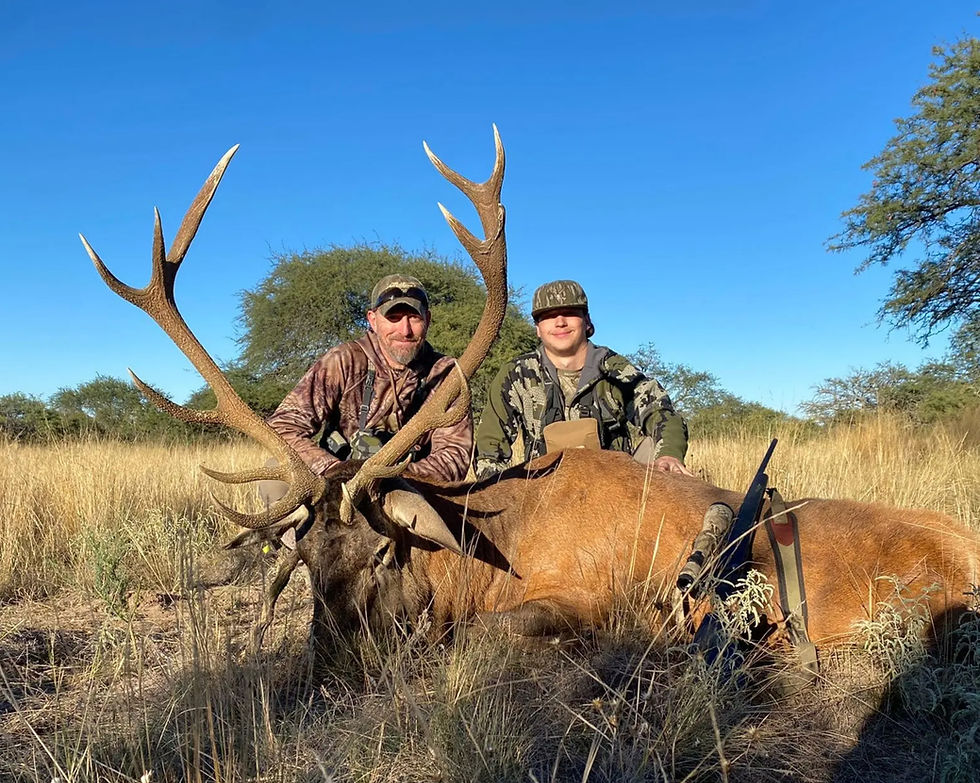
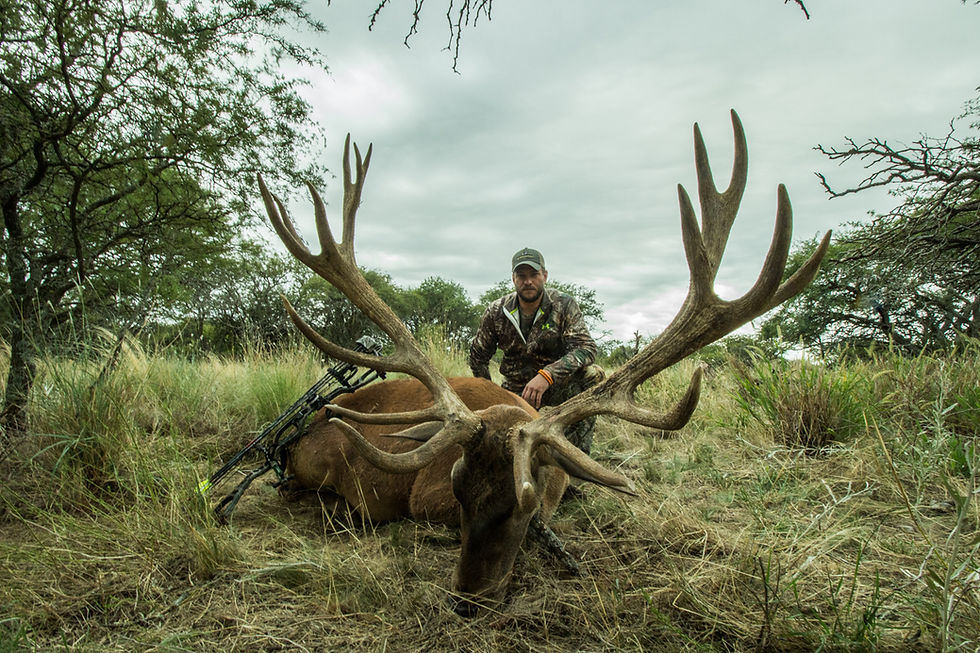
Red Stag Hunting in Texas vs. Argentina

Texas and Argentina both offer red stag, but they are not the same hunt. Texas red stag live on high-fenced ranches, can be hunted year round and sit a short drive from most American hunters. Argentine stags run free range across tens of thousands of unfenced acres, and the season is built around the autumn roar.
Texas vs. Argentina at a Glance
Texas | Argentina | |
Typical property | High fence, most exotic ranches | Free range, no perimeter fence |
Ground you hunt | Hundreds to a few thousand acres | 30,000 to 150,000 acres per ranch |
Season | No closed season, exotics are classified as exotic livestock | March 1 to August 31 |
Best window | September to February for hard antler | Mid-March to mid-April, the roar |
Bag limit | None set by the state | Set by the outfitter and the property |
License | Texas hunting license required, no special exotic permit | Arranged by the outfitter |
Travel from the US | Drive or a short domestic flight | Direct overnight flight to Buenos Aires |
Jet lag | None | None, same time zone band as the US east coast |
Method | Often stand or blind, some spot and stalk | Spot and stalk by foot and horse, located by roar |
Combine with | Other Texas exotics | Water buffalo, blackbuck, axis, wingshooting, dorado |
The Real Difference: High Fence vs. Free Range
Everything else on that table follows from one line: the fence.
Most Texas red stag live behind a high game fence. That is not a criticism of Texas ranches, it is how the exotic industry there was built. Red deer are not native to North America, they are classified as exotic livestock rather than game animals, and the fence is what makes a managed population possible on private land.
The practical result is that a Texas stag lives his whole life inside a known boundary. The ranch knows roughly how many stags it holds, what they score and where they tend to be. For a hunter who wants a specific animal on a specific weekend, that predictability is the product.
In Argentina there is no fence. Our ranches run from 30,000 acres at Pampas Ranch to 85,000 at Poitahue and up to 150,000 in the Andes foothills, and the stags move across them and beyond them as they please. Nobody knows how many there are. You find them by covering ground and listening.
That is the trade. Texas sells certainty. Argentina sells the other thing.
How Much Ground You Are Hunting
Scale is the number most hunters underestimate.
A well-regarded Texas exotic ranch might run several hundred to a few thousand acres. Poitahue alone is 85,000 acres of Calden woods and open plains, and the Andes properties run from 70,000 to 150,000. At that size the animal is not managed in any meaningful sense. He is simply out there.
What that changes in the field is how you hunt. On smaller ground you often sit, because the animals cycle past known feed and water. On Argentine ground you walk, glass and drive between sections with your guide, and a day can end without a shot. That happens, and it is part of the deal.
Season: Year Round vs. the Roar
Texas has no closed season on red stag because the state does not classify exotics as game animals. You can legally hunt one in July. In practice Texas ranches point hunters at September through February, when stags are in hard antler.
Argentina runs the opposite calendar for the obvious reason: the southern hemisphere autumn falls across our March to August. The season is March 1 to August 31, and the roar, which we call la Brama, peaks from mid-March to mid-April.
That inversion is worth more than it first looks. A North American hunter can hunt whitetail and elk at home in the fall, then hunt a roaring red stag in March without giving up a single day of his own season. The two calendars do not compete.
What the Hunt Actually Feels Like
During the roar a mature Argentine stag holds a harem of hinds and bellows at anything that challenges him. You hear him before you see him, often from a long way off on a cold still morning, and then you spend the next hour closing the distance on foot through Calden scrub or up an open hillside.
If you have hunted bugling elk in September, the sequence is familiar: locate by sound, close, judge, shoot. The animal is smaller and the country is different, but the hunt is the same hunt. We cover that comparison in detail in red stag vs. elk.
A Texas stag hunt is usually shorter and more controlled. Many are one or two day hunts, often from a stand or a vehicle-assisted stalk, with the animal identified in advance. For a hunter who wants a specific trophy and has a weekend, that is exactly right.
What Changes When There Is No Fence
The fence does not only change where the animal can walk. It changes how he behaves, and that is what you feel in the field.
A stag that has lived his whole life inside a boundary gets used to vehicles, feeders and people. He is not tame, but he is habituated. He will often hold at two hundred yards and look at you, which is why so many Texas hunts end with a clean, considered shot from a rest.
A free-range Argentine stag has none of that. He has been hunted by nothing in particular and spooked by everything, and during the roar he is running on adrenaline rather than caution. He will answer you, move toward you, and then catch a swirl of wind and be gone over a rise before you have the rifle up. We lose stags that way every season. It is the cost of the thing.
The second difference is pressure. On our ranches we hunt a small number of hunters across very large country, which means a stag may go his whole life without encountering a person. At Pampas Ranch that has been the management approach since 2000. On a smaller property the same animal would have been seen, judged and passed on a dozen times before he was mature.
None of this makes one hunt better in the abstract. It makes them different products. A hunter who wants the shot to happen should pick the fence. A hunter who wants the stalk to be uncertain should pick the open country.
Judging a Stag in Each Country
Trophy judging also differs, and it catches people out.
On a managed Texas ranch you are often choosing from a known set of animals with known scores, sometimes from photographs before you arrive. The decision is made at a desk as much as in the field.
In Argentina you judge what walks out, in the time he gives you, usually while he is moving hinds. We look at body first, then mass through the beams, then length and spread, and the crown last. The call is made out loud with your guide, in seconds rather than minutes.
Licenses and Paperwork
Texas is simple. You need a Texas hunting license and nothing else. A non-resident five-day special hunting license runs about 48 dollars, a non-resident general hunting license about 315 dollars, and a resident license about 25 dollars. There is no exotic tag and no draw.
Argentina is also simple, but the work sits with the outfitter rather than with you. Hunting licenses and the provincial paperwork are arranged for you before you arrive. What you do need to plan for is bringing a rifle into the country or borrowing one, and getting your trophy home afterwards. Both are routine, and both are covered in our complete red stag hunting guide.
Cost: What You Are Actually Comparing
The honest comparison is not hunt price against hunt price. It is the total of hunt, travel and time.
Texas ranches typically price red stag by trophy quality, with the fee scaling up as the antlers get better, plus a daily rate. For most American hunters the travel cost is a tank of fuel or a cheap domestic ticket, and the trip can be done over a long weekend.
In Argentina our red stag packages start at USD 1,500 and the trip is built to measure around your dates, the days you want in the field and the species you want to add. The flight is an overnight from Miami, Dallas, Houston or Atlanta, and you should budget a week rather than a weekend.
Where Argentina changes the math is what else fits in the same trip. The ticket is the expensive part, and once you have paid for it you can add water buffalo, blackbuck, axis deer or a few days of high-volume wingshooting without buying another international flight. See the species on our big game hunting page.
Where Texas Wins
It would be dishonest to write this comparison without saying it plainly.
If you want a red stag on the wall, you live in the United States and you have a weekend rather than a week, Texas is the better answer. It is cheaper to reach, there is no season to wait for, no passport, no firearms paperwork and no trophy export. A good Texas ranch will put you in front of a heavy stag and you will be home for dinner on Sunday.
Argentina is not competing for that hunter. It is competing for the hunter who wants the animal wild, the ground big and the roar in his ears, and who is willing to spend a week and an international ticket to get it.
Which One Should You Pick?
Pick Texas if the trophy matters more than the hunt, if your time is short, or if you want to be certain of the outcome before you book.
Pick Argentina if you want free range and fair chase, if the roar is the point, if you want a week in the field rather than a weekend, or if you want to stack several species into one trip.
Plenty of hunters do both, and in opposite seasons, which is the argument that settles it for most people we take.
Frequently Asked Questions
Is red stag hunting in Texas high fence?
Most of it is. Red deer are not native to North America and are classified as exotic livestock rather than game animals, so Texas ranches manage them inside a high game fence. Free-range red stag in Texas exists but is uncommon.
Is red stag hunting in Argentina free range?
Yes. Our ranches run from 30,000 to 150,000 acres with no perimeter fence, and the stags move freely across and beyond them. Hunting is spot and stalk on foot and horseback.
Do you need a license to hunt red stag in Texas?
Yes, a Texas hunting license. There is no separate exotic permit, no tag and no draw. A non-resident five-day special license runs about 48 dollars and a non-resident general license about 315 dollars.
When is red stag season in Texas?
There is no closed season. Exotics have no state season or bag limit in Texas. Ranches generally recommend September through February, when stags are in hard antler.
When is red stag season in Argentina?
March 1 to August 31. The roar, known locally as la Brama, peaks from mid-March to mid-April, and that is the window most hunters travel for.
Which has better trophy quality, Texas or Argentina?
Both produce heavy stags. Texas ranches can manage genetics and nutrition inside a fence, which makes high scores more predictable. Argentina produces free-range animals across large unfenced country, where the trophy is less predictable and the hunt is longer.
How much does a red stag hunt in Argentina cost?
Our red stag packages start at USD 1,500, and the trip is built to measure around your dates, the number of days in the field and the species you want to add.
Can you hunt red stag in Texas and Argentina in the same year?
Yes, and the calendars make it easy. Texas has no closed season and points hunters at September to February, while the Argentine season runs March 1 to August 31. The two do not overlap in their best windows.
Plan Your Argentina Red Stag Hunt
We own and run our own ranches in La Pampa and the Andes foothills, and the four of us who own them host every group personally. If you want to compare dates, species and days in the field, contact us and you will be talking to the owners. You can also see the programs on our red stag hunting in Argentina page.