Red Stag vs. Elk: Key Differences Every Hunter Should Know

Updated: Oct 14
If you have chased bugling bulls in September, you already know 80% of what it takes to hunt a red stag. The two animals are so closely related that for most of the 20th century biologists called them the same species. But the 20% that is different — the antlers, the sound, the season, the country — is exactly what makes a red stag hunt worth a trip to the other end of the world.
This is a hunter's comparison of red stag vs. elk: how they stack up in size, antlers, vocalizations, behavior and hunting style, and what an elk hunter should expect on a free-range red stag hunting in Argentina trip. We have guided North American hunters through the Brama for more than three decades, and the question we hear most on the first night at the lodge is some version of "so how is this going to compare to elk?" Here is the long answer.
Red Stag vs. Elk at a Glance
Red Stag (Cervus elaphus) | Elk / Wapiti (Cervus canadensis) | |
Native range | Europe, North Africa, western Asia | North America, northeast Asia |
Where we hunt them | La Pampa and the Patagonian Andes, Argentina | Rocky Mountains, US and Canada |
Mature male weight | 350–550 lb (160–250 kg) | 700–1,100 lb (320–500 kg) |
Shoulder height | 4–4.5 ft (120–135 cm) | 4.5–5 ft (135–150 cm) |
Antlers | Shorter beams, multi-tined "crown" at the top; 10–16+ points on mature stags | Long sweeping beams, typically 6 points per side |
Rut call | Deep, guttural roar | High-pitched bugle with grunts |
Rut timing | Mid-March to mid-April (southern autumn) | Mid-September to mid-October |
Harem size | Smaller, 5–15 hinds | Larger, often 20+ cows |
Hunting method | Locate by roar, spot-and-stalk, calling | Locate by bugle, spot-and-stalk, calling |
Tags / draws | No draw; license arranged by the outfitter | Nonresident draws in most western states |
Are Red Stag and Elk the Same Species?
Not anymore, but they used to be. Until the early 2000s, the elk of North America and the red deer of Europe were classified as subspecies of one animal, Cervus elaphus. DNA work published in 2004 split them into two species: Cervus elaphus (red deer, whose mature males are called stags) and Cervus canadensis (elk, or wapiti). They remain sister species in the same genus, can interbreed where they overlap, and share the same basic rut behavior, which is why the hunting feels so familiar.
The red deer you hunt in Argentina descend from European stock. They were introduced to La Pampa in the early 1900s by Pedro Luro on his estancia near what is now Parque Luro, and later released in the Andean foothills of Neuquén. They found near-perfect habitat, low predator pressure and plenty of feed, and over a century they spread into some of the strongest free-range red deer populations anywhere in the world.
For a fuller picture of the animal on its own terms, see what a red stag is: size, weight, antlers and how it lives. And if your alternative is a closer hunt rather than a trip south, we compared red stag in Texas vs. Argentina.
Red Stag vs. Elk Size: How Big Is a Red Stag?
Elk are the larger animal. A mature Rocky Mountain bull runs 700 to 1,100 pounds on the hoof and stands about five feet at the shoulder. A mature red stag typically weighs 350 to 550 pounds and stands four to four and a half feet, so think of a stag as roughly two thirds of a bull elk in body.
That size gap changes two things in the field. First, shot placement and caliber: a stag is a tough animal but not an elk-sized one, so the same .270 to .300 magnum class rifles you already own are more than enough. Second, judging animals: an elk hunter's eye is calibrated to a bigger body, and the first few stags you glass will look smaller than they are. Trust your guide on age and antler, not your gut on body size.
Red Stag vs. Elk Antlers: Beams vs. Crowns
This is where the two animals part ways completely, and it is the reason a red stag trophy looks like nothing else on an elk hunter's wall.
Elk antlers are built on length. A mature bull carries two long, sweeping main beams that can pass 50 inches, with points growing off them in a line: brow, bez, trez, dagger and a royal near the top. A classic trophy is a heavy 6x6.
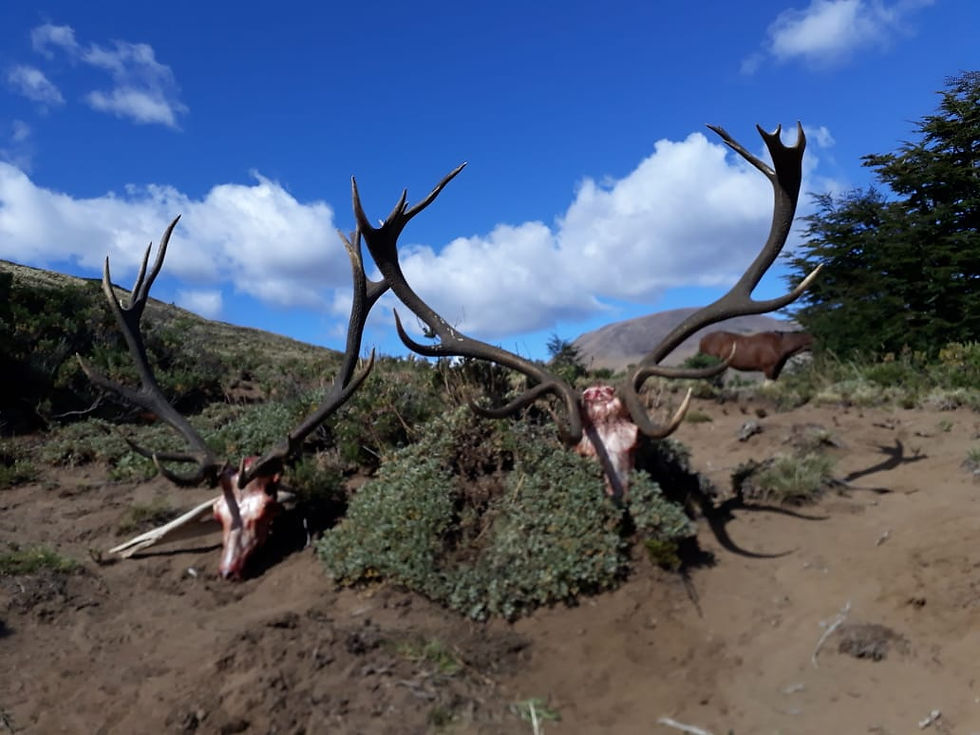
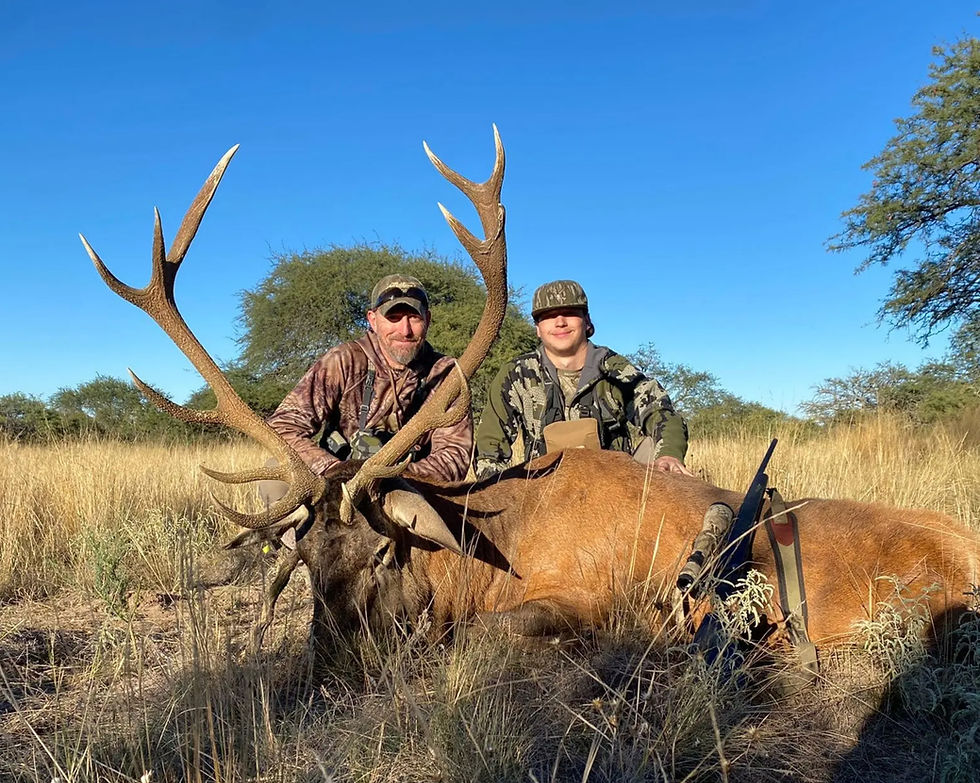
Red stag antlers are built on points. The beams are shorter and more upright, and the top of each antler splits into a cluster of three or more tines called the crown, or cup. Add the brow, bez and trez tines lower on the beam and a mature stag carries 10 to 16 points, with exceptional animals going well beyond that. Old European terminology still applies: a 12-point stag is a Royal, 14 is an Imperial and 16 is a Monarch.
Because of that structure, red stags are scored differently. SCI measures them with their own method that credits the number of points and the mass and length of the crowns, so a stag's score is not comparable to an elk score even at similar antler weight. Beam length matters much less than crown development and the number of long, heavy tines.

Trophy Quality: What a Free-Range Argentine Stag Looks Like
Age is everything in free-range stag hunting, and age comes from low pressure. Our La Pampa ranches take a handful of hunters per season over tens of thousands of unfenced acres, which lets stags reach seven, eight or nine years old, when the crowns finally fill out. A representative mature stag from La Gitana Ranch or Pampas Ranch carries heavy beams, long brow and bez tines and well-developed crowns. In SCI terms, mature free-range stags from La Pampa commonly score in the low-to-mid 300s, with the best animals of a season pushing toward and past 400.
In the Andes, at Andes Ranch, the trophies tend to be a touch lighter in mass than La Pampa stags but carry the weight of the setting: a mountain stag taken on foot, at range, with snow on the peaks behind it.
Ask us for recent trophy photos from the specific ranch and week you are considering. We would rather show you last season's stags than promise inches.
Red Stag Roar vs. Elk Bugle
If you have never heard a stag roar, no description quite prepares you, but here is the closest one: an elk bugle is a whistle that ends in a scream; a stag roar is a lion. It is deep, hoarse and guttural, delivered with the head laid back and the neck swollen, and it carries across a valley at dawn in a way that raises the hair on your arms.
During the peak of the Brama, the Argentine name for the red deer rut, a good valley in La Pampa or the Andes can have five, six, ten stags roaring at once, each answering the others. Elk hunters consistently tell us it is the single biggest emotional difference between the two hunts. The bugle is beautiful; the roar is primal.
Practically, the roar is also your locating tool, exactly as the bugle is in September. You listen at first light, pick a stag by the depth and cadence of his voice, and close the distance. Guides roar back to fire a stag up and pull him into range, the same way you would cow-call or bugle at a bull.
When Is the Rut? Two Seasons, One Calendar
The rut of the elk peaks from mid-September to mid-October. The Brama of the red stag in Argentina builds from the second week of March and peaks from roughly mid-March to mid-April, in the southern-hemisphere autumn.
For a North American hunter that reverse season is the whole opportunity. Your elk tags are filled or expired, your rifles are cleaned, and the best red stag weeks of the year fall in the dead quiet of your off-season. You can hunt both ruts in the same year without giving up a single day of either.
The full Argentine season runs from March 1 through August 31, so if you would rather trade the roar for milder weather and a quieter camp, the post-rut months from late April to June offer a superb classic glassing and stalking hunt. Our complete red stag planning guide breaks the season down month by month.
Behavior and Habitat: What Feels Familiar and What Does Not
What feels the same. Both are harem breeders. During the rut a mature male gathers and defends females, roars or bugles to warn off rivals, fights when the warning fails and drops his guard doing all of it. Satellite males hang on the edges. Mornings and evenings are prime. Wind is everything.
What is different. Red stag harems are smaller, typically 5 to 15 hinds against 20 or more cows for a herd bull, so you tend to work a single stag and his hinds rather than a whole hillside of elk. Stags are generally less nomadic than rutting bulls, holding tighter to a piece of ground once the roar is on, which makes them more predictable to pattern over a week. And in the Caldén woodland of La Pampa the cover is thick and the encounters are close and frequent, several stalks a day, so the hunt feels more like a whitetail-density experience than a long-glass Western elk hunt. The Andes are the opposite: big, open mountain country, spot-and-stalk on foot and horseback, with shots that can stretch from 100 to 500 yards.

Hunting Red Stag vs. Hunting Elk: The Practical Differences
No draw, no points, no lottery. Nonresident elk hunting in the best western units means years of preference points or long odds in a draw. In Argentina there is no draw. Your provincial hunting license is arranged by us as part of the trip, and you hunt the dates you book.
Fair chase, free range. Our red stag hunts are free range over vast unfenced land. No high fences, no put-and-take. If you are used to public-land elk, the ethics translate directly; the difference is the animal density and the age class you are hunting.
Guided, one-on-one. Every hunter has a professional local guide, usually with a tracker, for the whole week. That is the norm here, not a premium add-on.
Shooting distances. Closer and quicker in La Pampa's woods, so a rifle you mount fast matters more than raw ballistics. Longer in the Andes, where practice out to 300-plus yards and a good rangefinder pay off. Flat-shooting calibers from .270 to the .300 magnums cover both.
Bowhunters. The Brama is the best archery window in the red deer world. Roaring stags respond, close and hang up inside bow range in thick cover, and our La Pampa ranches are set up for archery stalks and blinds. See our page on bowhunting in Argentina if that is your plan.
Physical demands. A La Pampa stag hunt is walking-intensive but gentle underfoot. An Andes hunt is a genuine mountain hunt, more physical and more remote, sometimes with a night in a cabin or spike camp to be beside the roaring stags at first light. Both are far less punishing than a backcountry DIY elk hunt at 10,000 feet.
The rest of the trip. Reverse season also means Argentine autumn: crisp mornings, mild afternoons, asado and Malbec at the lodge, and easy add-ons like world-class wingshooting, trout fishing or a couple of days in Buenos Aires on the way home. Non-hunting partners are welcome and have plenty to do.
Which Hunt Is Right for You?
If you love the bugle, the calling game and the close-range adrenaline of the elk rut, the Brama will feel like coming home with the volume turned up. If you want a trophy that looks nothing like what is already on your wall, the crowned antlers of a mature red stag are unlike anything in North America. And if you are tired of waiting on draws, a free-range red stag hunt is a rut hunt you can book for the dates you want, in your off-season, with the logistics handled from the airport to the taxidermist.
Frequently Asked Questions
Is a red stag bigger than an elk?
No. A mature bull elk weighs 700 to 1,100 pounds; a mature red stag weighs 350 to 550 pounds. Elk are the larger-bodied animal, but red stags carry more antler points, with multi-tined crowns instead of long beams.
Are red stag and elk the same species?
Not anymore. They were classified as one species until DNA studies in 2004 split them into red deer (Cervus elaphus) and elk (Cervus canadensis). They are closely related sister species with very similar rut behavior.
How many points does a red stag have?
A mature red stag typically carries 10 to 16 points, and exceptional animals more. A 12-point stag is called a Royal, a 14-point an Imperial and a 16-point a Monarch. Elk typically carry 6 points per side on long beams.
What does a red stag roar sound like compared to an elk bugle?
An elk bugle is a high-pitched whistle that ends in a scream. A red stag roar is deep, hoarse and guttural, often compared to a lion. During the peak of the Brama several stags may roar at once.
When is the red stag rut in Argentina?
The Brama builds from the second week of March and peaks from mid-March to mid-April. The full season runs March 1 through August 31. Elk rut in mid-September to mid-October, so a hunter can do both in the same year.
Is hunting red stag in Argentina similar to hunting elk?
Very. You locate a stag by his roar at first light, spot-and-stalk or call him in and take a specific mature animal. The main differences are the smaller harems, the thick Caldén cover in La Pampa and that the hunt is fully guided with no draw required.
What rifle caliber works for red stag?
The same rifles you use for elk. Flat-shooting calibers from .270 to the .300 magnums are ideal. In La Pampa shots come close and fast; in the Andes practice out to 300-plus yards.
Do I need to draw a tag to hunt red stag in Argentina?
No. There is no draw or points system. Your provincial hunting license is arranged by Argentina Heritage Outdoors as part of your trip, and you hunt the dates you book.
Plan Your Free-Range Red Stag Hunt
Ready to hear a stag roar? Tell us your dates and what you are after and we will build the trip around you: ranch, rut timing, species and logistics included. Contact us to start planning your red stag hunting in Argentina trip, or ask us for a reference list of past elk hunters who made the trip south.
Email info@argentinaheritageoutdoors.com · USA: +1 305 440 0261 · ARG: +54 911 3680 5893
Life is about moments — don't wait for them, chase them.