What Is a Red Stag?

A red stag is a mature male red deer, Cervus elaphus, the same species that North Americans know as a close cousin of the elk. Mature stags weigh 350 to 550 pounds, carry branched antlers that end in a crown of points, and roar instead of bugling. In Argentina they run free range across La Pampa and Patagonia.
Red Stag at a Glance
Red stag (Cervus elaphus) | |
What the word means | The adult male. The female is a hind, the young is a calf |
Mature male weight | 350 to 550 lb (160 to 250 kg) |
Shoulder height | 4 to 4.5 ft (120 to 135 cm) |
Antlers | Branched beams ending in a crown; 10 to 16 or more points on a mature stag |
Rut call | A deep, guttural roar |
Rut in Argentina | Mid-March to mid-April, known locally as la Brama |
Hunting season in Argentina | March 1 to August 31 |
Native range | Europe, North Africa, western Asia |
Where we hunt them | La Pampa and the Patagonian Andes, Argentina |
Lifespan in the wild | 12 to 15 years |
Stag, Hind, Deer: Getting the Words Right
The vocabulary trips up most first-time visitors, so it is worth settling early.
Red deer is the species. Red stag is the adult male. Hind is the adult female, and a calf is the young of the year. A young male is a spiker or a brocket depending on where you are, named for the single unbranched beam he carries in his first years.
So "red stag" and "red deer" are not two animals. Every red stag is a red deer, in the same way every bull is a cow in the broader sense of the species. When you see an outfitter advertise red deer hunting and another advertise red stag hunting, they are usually offering the same thing.
One more distinction matters for North American hunters: red deer and elk were classified as a single species for most of the twentieth century. Genetic work has since separated them into Cervus elaphus and Cervus canadensis. They remain close enough to interbreed, which is why a bull elk and a red stag look like variations on one design. The differences are covered in detail in our comparison of red stag vs. elk.
How Big Do Red Stags Get?
A mature free-range stag in Argentina weighs 350 to 550 pounds on the hoof and stands 4 to 4.5 feet at the shoulder. That makes him noticeably smaller than a Rocky Mountain bull elk, which runs 700 to 1,100 pounds, and considerably larger than a mature whitetail buck.
Body size varies with ground and age. Stags on the agricultural country of La Pampa, with Calden woods and crop edges to feed on, carry more weight than stags living high in the Andes foothills, where the country is drier and the walking is harder. A stag does not reach his peak until roughly his seventh to tenth year.
What surprises most hunters is not the body. It is how the animal carries himself. A mature stag in hard antler during the roar moves with his neck swollen, mane up and head tipped back, and he looks far bigger in the field than the scale later says he was.
Antlers: Crowns, Royals and Imperials
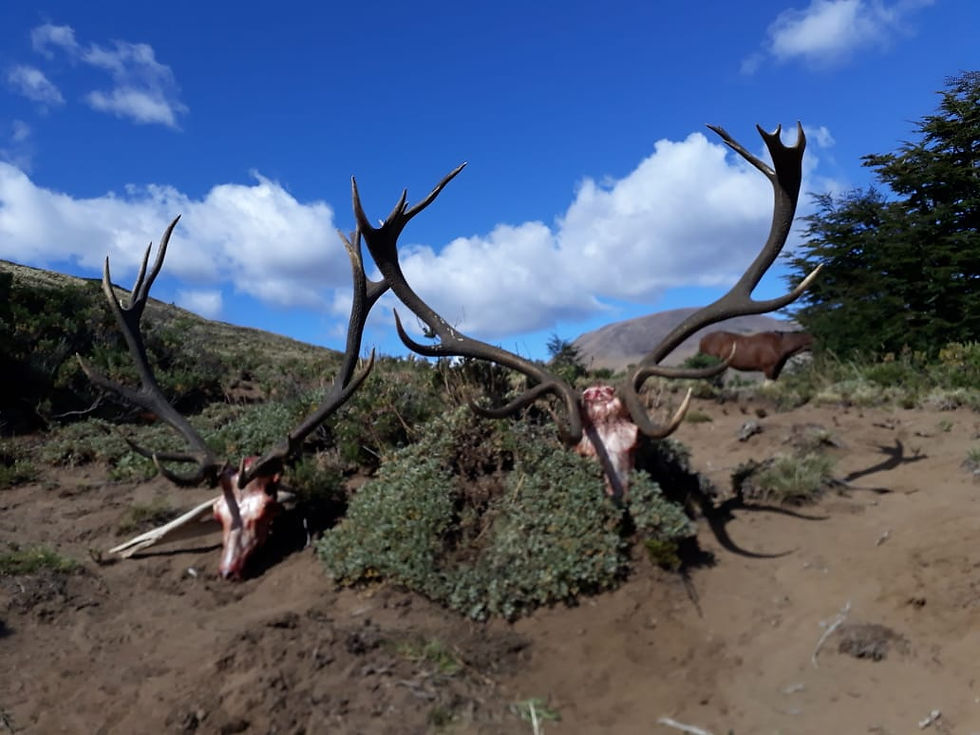
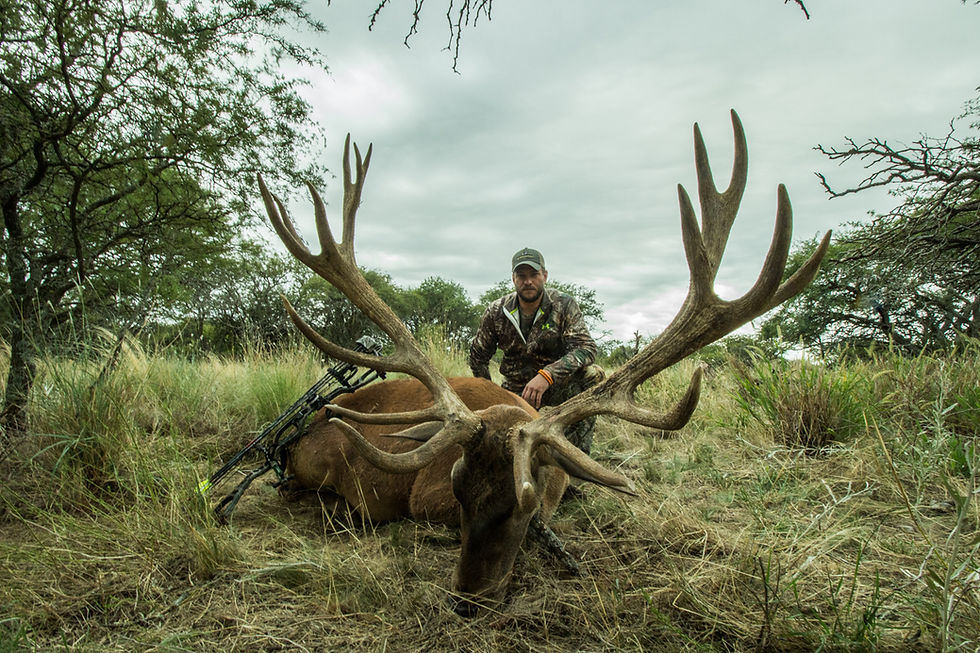
Elk antlers sweep back in long beams with points coming off at regular intervals. Red stag antlers do something different: the beam rises, throws tines forward and low, and then finishes in a cluster of points at the top. That cluster is the crown, and it is the single feature that defines a good stag.
European tradition names stags by their point count:
Royal: 12 points
Imperial: 14 points
Monarch: 16 points or more
A mature free-range stag in Argentina typically carries 10 to 16 points. Point count alone does not tell the whole story. Beam length, mass, the spread between the beams and the shape of the crown all matter, and two stags with the same number of points can look completely different on the wall.
Antlers are shed and regrown every year. In the southern hemisphere stags cast their antlers in the southern spring, around September and October, and carry hard antler through the autumn roar. That cycle is why the Argentine season runs when it does.
Where Red Stags Live
Red deer are native to Europe, North Africa and western Asia. They were introduced to New Zealand, Australia, Chile and Argentina during the nineteenth and early twentieth centuries, and free-ranging populations established themselves well enough that the southern hemisphere now offers some of the best stag hunting in the world.
In Argentina the animal found country that suited it. The Calden woods and open plains of La Pampa give cover, feed and water. Further south, the foothills of the Andes give high open ground and timbered draws. Both hold free-range stags today, and both are where we hunt them. You can see the ranches on our big game hunting page.
How Red Stag Came to Argentina
Red deer arrived in Argentina in the early twentieth century, brought in by European landowners stocking private estancias. The animals did what introduced deer tend to do in good country with few predators: they spread, and they kept spreading.
Today the descendants of those animals live wild across hundreds of thousands of acres. That history is the reason Argentina can offer genuinely free-range stag hunting at a scale that is hard to find in Europe, where most red deer are hunted on managed estates.
What Does Red Stag Meat Taste Like?
Red stag is excellent eating, and it is one of the reasons the species has been farmed commercially in New Zealand for decades.
The meat is lean, fine grained and dark, closer to elk than to whitetail. It carries less of the strong flavor that some hunters associate with older deer, and because the animals feed on grass and crops rather than browse alone, the taste is clean. Backstraps and tenderloins cook like beef and want nothing more than salt and fire. Shoulders and necks reward slow cooking.
At our lodges the meat from the day's hunt often goes straight to the asado that evening, which remains the best argument for the species that we know.
How We Judge a Stag in the Field
Point count is the easiest thing to see and the least useful thing to judge on. A stag can carry sixteen points and still be a young animal with thin beams, and an older stag can lose points from his crown and still be the better trophy.
What we look at first is the body. A mature stag has a deep chest, a heavy neck that thickens further during the roar, and a dark mane. He stands differently from a younger animal, and in the field that outline tells you more at four hundred yards than the antlers do.
Then the antlers, in this order: mass through the beams, length, the width of the spread, and last the crown. A heavy stag with a modest crown is usually a better animal than a light one with a showy top.
The hardest part is that a stag in a harem is rarely alone or still. He is moving hinds, answering challengers and watching his flanks, and you often get seconds rather than minutes to decide. This is why we hunt one on one with a guide: the decision is made together, out loud, before the rifle comes up.
If you have hunted mature bull elk, none of this will feel foreign. The animal is different, the ground is different, but the judgment is the same judgment.
When and How We Hunt Them
The Argentine red stag season runs from March 1 to August 31. The roar, which Argentines call la Brama, peaks from mid-March to mid-April, and that is the window most hunters travel for.
During the roar a mature stag holds a harem of hinds and answers challenges with a deep, rolling bellow that carries a long way on a still morning. You locate him by sound, then close the distance on foot. It is spot and stalk hunting with an audible target, which is why elk hunters take to it immediately.
Outside the roar, stags are hunted by glassing and stalking on open ground. The hunting is harder and quieter, and the trophies are no worse.
For the full picture, including regions, trophy quality, rifles and how to plan the trip, read our complete red stag hunting guide. If you are ready to look at dates, our red stag hunting in Argentina page lays out the programs.
Frequently Asked Questions
What is the difference between a red deer and a red stag?
Red deer is the species. Red stag is the adult male of that species. The adult female is called a hind. Outfitters who advertise red deer hunting and red stag hunting are usually offering the same animal.
How much does a red stag weigh?
A mature red stag weighs 350 to 550 pounds on the hoof and stands 4 to 4.5 feet at the shoulder. That is smaller than a bull elk, which runs 700 to 1,100 pounds, and larger than a mature whitetail buck.
How many points does a red stag have?
A mature free-range stag typically carries 10 to 16 points. European tradition calls a 12-point stag a royal, a 14-point stag an imperial and a 16-point or better stag a monarch.
Is a red stag the same as an elk?
No. They are separate but closely related species, Cervus elaphus and Cervus canadensis. They were classified as one species for most of the twentieth century and can still interbreed, but they differ in size, antler shape and the sound they make during the rut.
Do red stags bugle like elk?
No. A red stag roars. It is a deep, guttural bellow rather than the high-pitched whistle of a bull elk, and it carries differently across open country.
When do red stags shed their antlers?
In the southern hemisphere stags cast their antlers around September and October, then grow a new set through the summer and carry hard antler through the autumn roar.
What does red stag meat taste like?
Lean, fine grained and dark, closer to elk than to whitetail. It is mild for a deer species because the animals feed heavily on grass and crops.
Where can you hunt free-range red stag?
Argentina, New Zealand and parts of Europe. Argentina offers free-range hunting across large private properties in La Pampa and Patagonia, with a season that runs March 1 to August 31.
Plan Your Red Stag Hunt
We run our own ranches in La Pampa and the Andes foothills, and the four of us who own them host every group personally. Contact us to talk about dates, and you will be talking to the owners.